
A certificate of occupancy is the city's sign-off that a property is fit to be occupied — and concrete is one of the things that can hold one up. It comes up three ways in our work: new construction waiting on final approval, a home sale where the city inspects before the deal can close, and a landlord who needs a rental property certified before a tenant can move in. Different reasons, same problem: a deadline, and flatwork that has to pass.
The short version
Cracked, sunken or heaved flatwork is a common violation, and you generally cannot get a certificate of occupancy until it is corrected and re-inspected. Small pours can often be done in a day or two. What kills deadlines is not the concrete work — it is the permit, the required mid-job inspections, the re-inspection queue and the weather. Start the day you have the report.
Three ways a C of O lands on your plate
A certificate of occupancy certifies that a property meets the local codes and ordinances and is suitable to be occupied. In Metro Detroit it tends to reach a homeowner or landlord in one of three ways.
New construction. A new build needs final sign-off before anyone moves in, and the exterior flatwork is part of what gets inspected — driveway, service walk, porch, garage floor. This is the version with the most inspections attached, because the city has been involved from the footings up.
A home sale. Plenty of communities require a pre-sale inspection, with any violations corrected and re-inspected before the certificate is issued. In Dearborn, for example, the residential pre-sale housing inspection is required by ordinance, the seller schedules it, and the certificate is prepared in the purchaser's name — you have to pass a re-inspection before it is issued.
A rental property. This is the one people underestimate. Many cities require a certificate before a rental can be occupied, and often again when tenants change. A landlord with a unit sitting empty is losing rent every week the concrete violation goes unfixed, which makes these some of the most time-sensitive jobs we take.
Requirements vary a lot between communities and they change. Some inspect on every sale, some only on new construction or vacant property, some have dropped requirements they used to have. Do not rely on what applied in a different city five years ago — call the building department where the property actually is.
What inspectors actually flag on flatwork
These are not aesthetic judgments. Inspectors are looking for safety and property-maintenance issues, and on concrete that usually comes down to a short list:
- Trip hazards. This is the big one. A vertical offset between two slabs is the single most common concrete violation. Southgate's exterior checklist, to take one published example, flags trip hazards of three-quarters of an inch or greater on driveways, sidewalks, walkways and patios.
- Cracked, raised or sunken slabs — sections that have heaved from frost or settled from a failing base.
- Porch and step problems. Significant cracking, excessive spalling, tipping that affects safety, sinking or sloping, and missing handrails or guardrails.
- Deteriorated surfaces where the concrete is actively crumbling rather than simply worn.
Michigan makes all of this worse than it would be elsewhere. Freeze-thaw cycling heaves slabs and opens joints every winter, so a driveway that was fine three years ago can easily be a violation now. Our guide on why concrete cracks here covers the mechanism.
The public sidewalk is a separate problem
Worth knowing before you assume one inspection covers everything: in Dearborn, the pre-sale inspection does not include a thorough inspection of the public sidewalk. That is handled by the Engineering Division separately.
It matters because the public sidewalk and the drive approach sit in the city right-of-way, which is a different jurisdiction from your driveway even though they meet at a seam. In Dearborn, only licensed contractors registered with the city can pull permits for work on public property — city sidewalks, approaches and curb cuts. A homeowner cannot pull that one, whatever anybody tells them.
What can be fixed fast, and what cannot
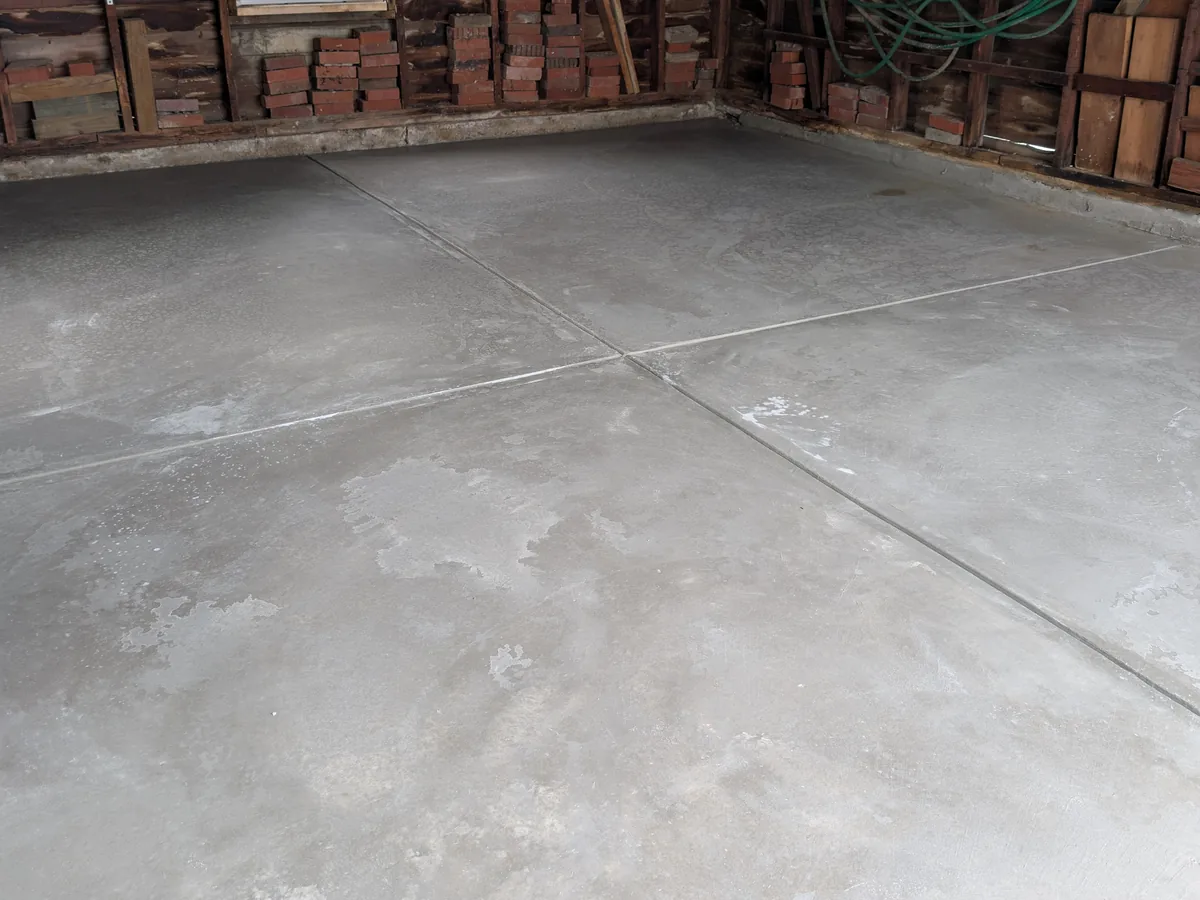
The honest answer is that the concrete itself is rarely the bottleneck. A garage floor, a service walk, a section of driveway — those are one-day pours for a crew that shows up prepared. We did exactly that in Dearborn recently: tear-out, base, pour and finish inside a single day because the homeowner needed the slab down for a C of O inspection.
What actually threatens the date:
- The permit. Concrete work needs one, and permits take time to process. This is the step people forget when they assume the job is "just a small pour."
- Required inspections mid-job. Dearborn garage floor replacements require a forms inspection before the concrete goes in, with the expansion joint already installed. You cannot pour, then call. If the forms inspection has not happened, the pour waits.
- The re-inspection queue. Fixing the violation is not the finish line. The city has to come back and verify it.
- Weather and cure time. Concrete does not care about your deadline. Our post on how long concrete takes to cure explains what you can and cannot rush.
Add those up and a "one-day pour" can still take a couple of weeks end to end. That is why the single most useful thing you can do is start the moment you have the report in hand — not the week before your deadline.
Dearborn's specs, since people ask
If the work is in Dearborn, the city publishes what it expects. Concrete must be air entrained at five to seven percent total air content with a minimum compressive strength of 3,500 PSI. Driveways, patios, walks and parking areas are a minimum of four inches thick. The driveway approach and the sidewalk in front of it are a minimum of six inches. Base course has to be clean graded sand, gravel or crushed stone, compacted to give the slab uniform support.
For garage floors specifically, all the old concrete has to come out, the new slab is saw cut two to six inches in from the inside edge of the wall plate, and approved expansion joint material runs the full depth of the pour around the complete perimeter — installed before that forms inspection.
There are also coverage limits people trip over: residential concrete and brick paver coverage cannot exceed 25 percent of the total property, and front-yard flatwork cannot exceed 40 percent of the front yard. If you were planning to widen a driveway while you were at it, check that first. Variances go to the Zoning Board of Appeals, which is not a fast process.
These figures come from Dearborn's published concrete permit information, and the fee schedule in that document is some years old, so confirm current permit costs with the city rather than budgeting from what you read here. Other cities set their own numbers — our permit guide covers the wider picture.
The permit trap worth avoiding
Dearborn allows homeowners to pull permits for work on their own private property — driveways, service walks, porch caps, garage floor replacements. The city also states plainly that homeowners are discouraged from obtaining permits on behalf of a contractor, because the city addresses code and ordinance issues with whoever holds the permit.
Read that again if you are mid-sale. If a contractor asks you to pull the permit in your name, you are the one the city comes to when something does not meet code — while you are trying to close on the house. It is also, frequently, a sign the contractor cannot pull it themselves. We cover that and the rest of the warning signs in how to choose a concrete contractor.
If you are staring at a violation and a deadline
Send us the inspection report. We will tell you what the concrete work involves, whether it can realistically be done in your window, and if it cannot, we will say so rather than take the job and leave you explaining a delay to a buyer, a tenant or a builder.
Tell us the deadline in the first message and tell us which kind it is — a closing date, a tenant move-in, or a final inspection on a new build. They carry different amounts of flexibility, and it changes how we schedule. It is the single most useful thing you can put in that first call.