
If your driveway, patio or sidewalk was poured this year, follow one rule this winter: no rock salt and no deicing chemicals of any kind. Use plain sand for traction instead. Michigan concrete-industry guidance is clear on this — and getting it wrong can permanently scar a brand-new slab.
The short version
Isolated problem — one cracked slab, one settled section — can often be repaired by cutting out and replacing just that piece. Widespread problems — cracking across the driveway, settling at multiple joints, spalling, crumbling edges — mean the base has failed, and patches are money spent delaying the inevitable. Here's how to tell which one you're looking at.
Nobody wants to hear "you need a new driveway" — and honestly, not everybody does. Some problems are genuinely repairable, and a contractor who says otherwise is selling you concrete you don't need yet — one reason it's worth knowing how to vet a concrete contractor before you commit. But the reverse is worse: paying for patch after patch on a driveway whose base has already failed. This guide is how we actually make the call, sign by sign.
The signs it's replacement time
Cracking across multiple slabs. One crack is a slab problem. Cracks in several sections — especially wide ones, or "map cracking" that spiders across surfaces — mean the base underneath has moved or washed out. Here's why that happens in Michigan, and no surface fix reaches it.
Settling and heaving at the joints. When slabs sit at different heights — trip edges, a section that's sunk toward the garage, panels that rock under the car — the ground under them has failed. The concrete is just reporting the news.
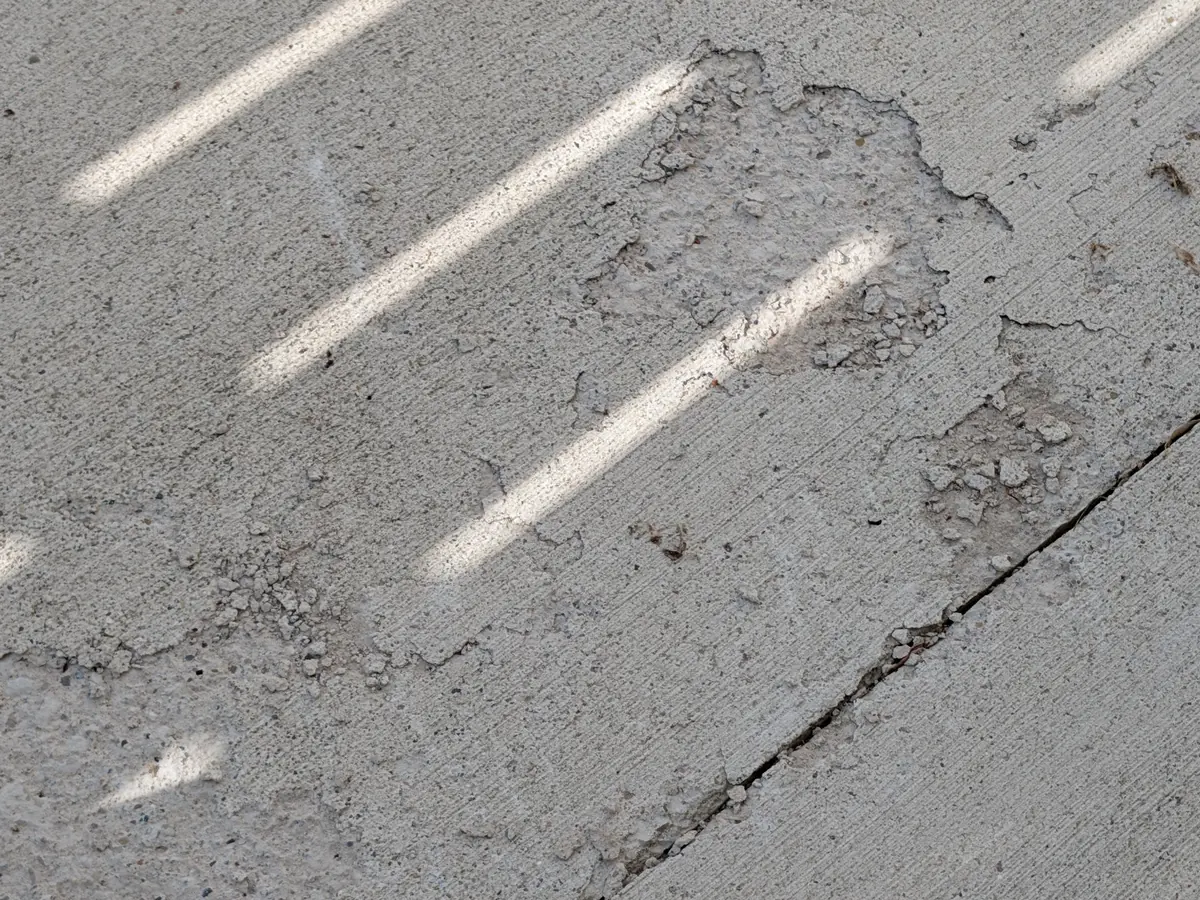
Spalling and surface scaling. When the top layer flakes off and exposes the aggregate underneath — like the photo above — the surface itself is failing, usually from de-icing salt on concrete that wasn't protected. We wrote a full guide to spalling; the short version is that it spreads, and there's no un-flaking a surface.
Crumbling edges and corners. Edges breaking off in chunks means the concrete is failing where it's weakest first. The middle follows.
Water going the wrong way. If the driveway pitches toward the house or ponds in the middle, that's a grading problem cast in concrete — and it feeds every other problem on this list, plus your foundation. You can't re-slope a slab.
Age. A properly poured driveway serves 25–30 years in Michigan. If yours is there and showing any of the above, it doesn't owe you anything — and money spent patching it is money not spent on its replacement.
When repair genuinely is enough
Here's the honest other side. If the damage is isolated — one cracked panel from a root, one settled slab at the sidewalk, a broken section where the dumpster sat — the right fix is often cutting out and replacing just that slab. Done right, with the base recompacted under the new section, it's a real repair that lasts. That's work we do.
What we won't sell you: crack fillers, patch products and skim coats over widespread damage. They're cosmetic. The crack comes back through the filler — usually by the second winter — because the thing that cracked the concrete is still under there. If a quote is mostly caulk and promises, you're buying a delay, not a repair.
The resurfacing question
Resurfacing — a thin overlay on the existing slab — gets searched a lot, so here's the straight answer: an overlay is only as good as the concrete under it. On a sound slab with cosmetic wear, it can work. On a driveway that's cracking or settling, the overlay inherits every problem underneath and shows them again within a few seasons — you've repaved the symptom. In Michigan freeze-thaw, driveway overlays are a niche solution to a narrow problem most failing driveways don't have.
The mudjacking and foam-leveling question
Slab lifting — mudjacking or polyurethane foam — is real and has its place, so we'll be straight about it even though we don't offer it: it's the right call when concrete is structurally sound but settled. A sunken sidewalk square, a slab that's dropped at one joint but is otherwise clean — lifting can fix that for less than replacement.
Where it's the wrong spend: concrete that's cracking, spalling or crumbling. Lifting a deteriorating slab just raises the deteriorating slab — you pay to put a failing surface back at the correct height. If a leveling quote and a replacement quote are on your table, the question to ask is whether the surface itself has years left. If it doesn't, level money is patch money.
The math, honestly
Replacement is the bigger number, so it deserves real figures: our broom-finish remove-and-replace runs $10.20–$13.20 per square foot by project size — tear-out, haul-away and base prep included — with a $5,400 minimum. A typical 600 sq ft driveway lands around $6,800. Full tiers and worked examples are in the cost guide, and the instant estimator gives your number in a minute.
Against that, price the patch path honestly: filler and skim coats every couple of years, maybe a leveling job, all on a driveway still marching toward replacement — and every dollar of it is gone when the tear-out finally happens. Repair the repairable, replace the failed, and don't pay twice.
Not sure which one you're looking at?
Send us a photo — text it to (313) 648-8390 — or get a ballpark from the estimator and we'll tell you at the free measure whether your driveway needs one slab, a full replacement, or honestly nothing yet. We've told plenty of homeowners to wait a few more years, and we'll tell you too. And once the new pour is in: sealing on schedule is how you keep from reading this article again in 2040.
Get a Free Estimate
Family-run and serving Metro Detroit since 1989. Get an instant ballpark online, then a free on-site quote.