
If your driveway, patio or sidewalk was poured this year, follow one rule this winter: no rock salt and no deicing chemicals of any kind. Use plain sand for traction instead. Michigan concrete-industry guidance is clear on this — and getting it wrong can permanently scar a brand-new slab.
The short version
Steps and sidewalks are small jobs where the details matter most — base prep, joint spacing and drainage decide whether they stay flat or heave after one winter. Because they're small, they're usually poured alongside a driveway or porch rather than on their own. Here's what to know before you get quotes.
Steps and sidewalks don't get the attention driveways and patios do, but they're the concrete you actually touch every day — the walk to your door, the steps up to the porch, the path to the backyard. And because they're small and narrow, they're the concrete that most often heaves, cracks and trips people when it's done wrong. The good news: done right, they're straightforward and they last.
Why the small jobs are where prep matters most
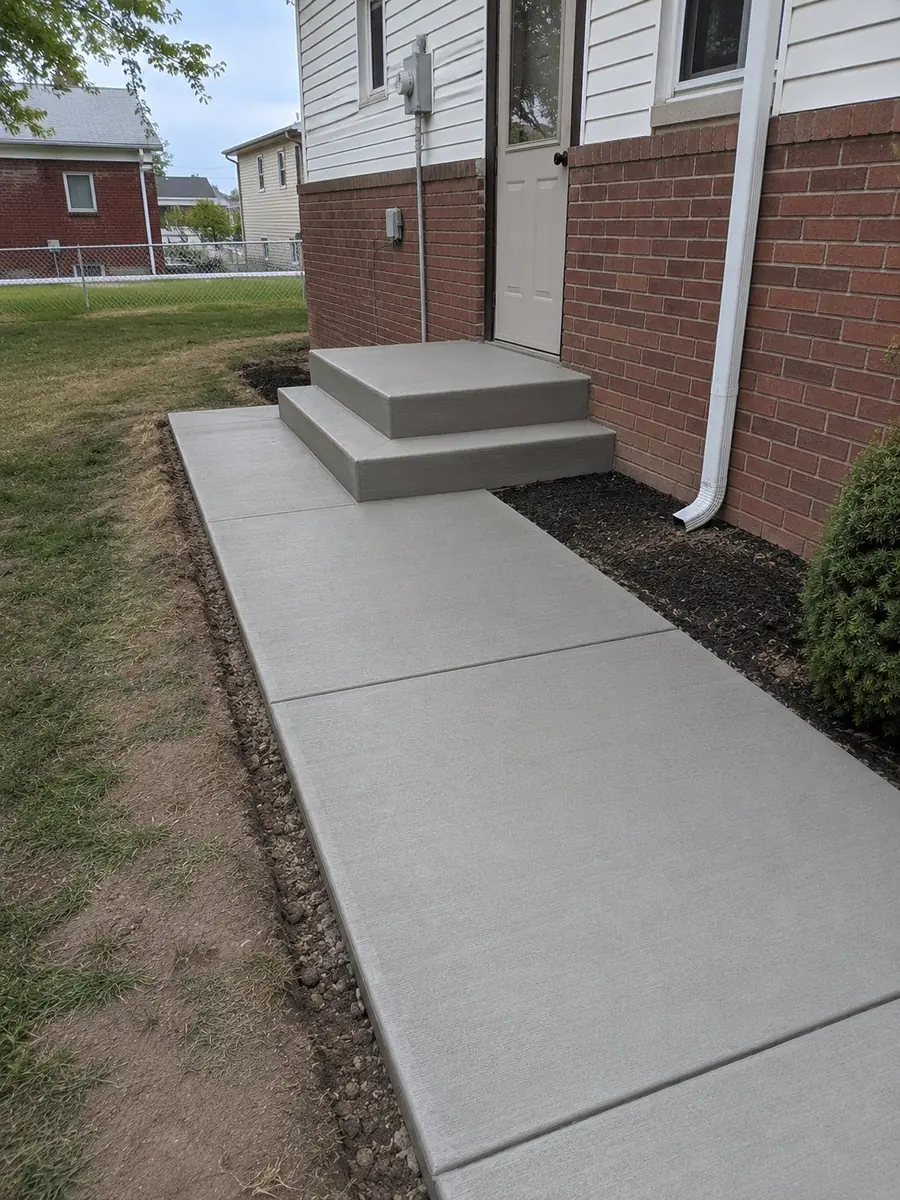
Here's the counterintuitive part: a driveway is a big flat mass that's fairly forgiving. A sidewalk is a narrow ribbon and steps are shallow slabs — both have far less mass to resist the ground moving under them. That's exactly why they're the first thing to heave in a Michigan winter. Water gets under a slab that wasn't set on a properly compacted base, freezes, expands, and lifts it. Come spring it settles back unevenly, and now you've got a trip edge.
The fix isn't thicker concrete — it's what's underneath. Compacted base, proper grading so water drains away instead of pooling under the slab, and control joints placed so the concrete cracks where you want it to. Get those three right and steps and sidewalks last decades; get them wrong and no amount of good concrete on top saves them.
Control joints: where your sidewalk decides to crack
All concrete moves, and all concrete eventually cracks somewhere — joints just decide where. On a standard 4-inch-thick walkway, control joints every 4 to 5 feet give the concrete a planned place to crack cleanly instead of wandering a jagged line across the middle. It's simple math — joint spacing in feet around two to three times the slab thickness in inches — and it's one of the most-searched and least-understood details in concrete. We wrote a full explainer on control joints if you want the why behind it.
Steps: code, safety, and why they're priced differently
Steps aren't priced by the square foot like flatwork — they're priced by the flight, because what matters is the height, the width, the number of risers, and whether they tie into a porch or landing. Beyond price, steps are the one place concrete work crosses into safety and code: consistent riser height matters (uneven risers are the classic trip hazard), and steps at an entrance may fall under local building requirements for dimensions and, above a certain height, railings.
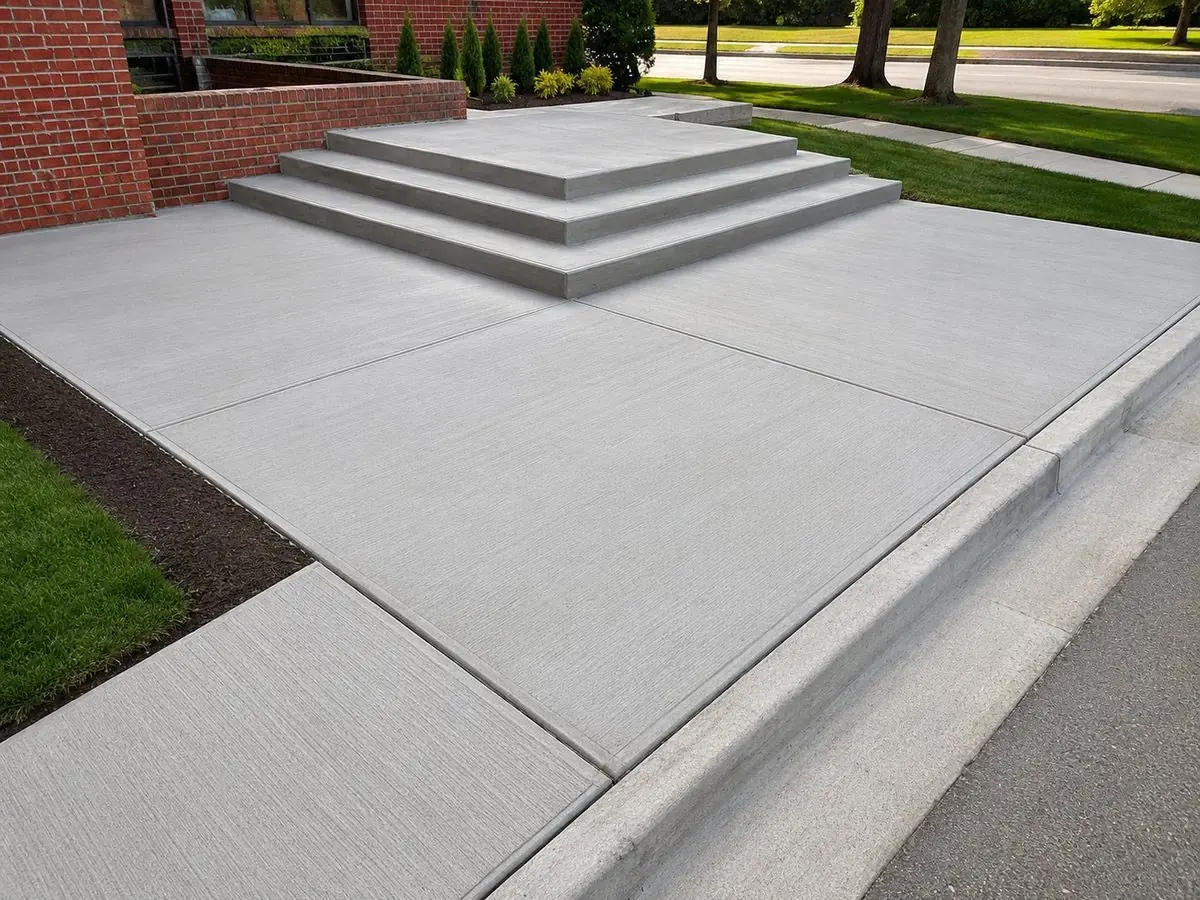
This is also why we usually pour steps alongside another job rather than on their own. A flight of steps by itself is a small ticket — typically under our $5,400 project minimum — so it makes sense paired with the walkway, porch or driveway it connects to. If your steps are all that's failing, that's worth an honest conversation about whether they need full replacement or can be addressed another way.
What they cost
Sidewalks and walkways price like other flatwork — our broom-finish rate runs $10.20–$13.20 per square foot by size, tear-out and base prep included. A typical front walk is small enough that it usually rides along with a bigger job to clear the $5,400 project minimum. Steps price by the flight as described above. The honest bottom line: steps and sidewalks are rarely a standalone project — they're the finishing touch on a driveway or porch job, and pricing them together is almost always the better value. The instant estimator gives you a ballpark for the whole thing.
Keeping them alive through winter
Once they're in, steps and sidewalks face the same enemy as everything else here: de-icing salt. Because they're narrow and heavily salted — nobody wants an icy front walk — they take more chemical abuse per square foot than a driveway does. Keep rock salt off new concrete through its first winter, use sand for traction instead, and seal them on schedule. A sealed, properly based sidewalk shrugs off winters that destroy a poorly built one.
Getting steps and sidewalks done right
We pour walkways, front walks, service walks, porch steps and stairs throughout Metro Detroit — usually as part of a driveway or porch project, sometimes on their own when the scope justifies it. If your walk is heaving or your steps are crumbling, text a photo to (313) 648-8390 or get a ballpark from the estimator, and we'll tell you at the free measure whether it's a repair, a replacement, or something to bundle with other work you're already considering.
Get a Free Estimate
Family-run and serving Metro Detroit since 1989. Get an instant ballpark online, then a free on-site quote.