
If your driveway, patio or sidewalk was poured this year, follow one rule this winter: no rock salt and no deicing chemicals of any kind. Use plain sand for traction instead. Michigan concrete-industry guidance is clear on this — and getting it wrong can permanently scar a brand-new slab.
The short version
Yes, we pour concrete for a living — so read this knowing that. But the honest math holds up: in Michigan, concrete usually costs less installed, needs less maintenance, and handles freeze-thaw as one slab instead of a thousand individual pieces. Pavers genuinely win in a few specific situations, and we'll tell you exactly which ones.
Every patio conversation in Metro Detroit eventually arrives at the same fork: a poured concrete patio, or pavers? Both make a good patio. But they're different systems that age differently in a freeze-thaw climate, and the brochures for each conveniently skip the other one's strengths. Here's the comparison we'd want if it were our backyard — including the situations where we'd tell you to go buy pavers.
The real difference: one piece vs. a thousand pieces
A concrete patio is a single engineered slab — poured on a compacted base, reinforced, with control joints cut where movement is planned. A paver patio is hundreds of individual blocks sitting on a sand setting bed over a gravel base, held together by edge restraint and joint sand. Neither is "cheap" done right; in fact a proper paver base takes just as much excavation and compaction as ours do. The difference is what happens over the next fifteen Michigan winters.
Where pavers genuinely win
Fair is fair. Pavers are repairable one unit at a time — if a corner settles or a block stains, you can lift and reset it. There's no cure time; you can grill on a paver patio the evening it's finished. They're stageable for DIYers who want to build a weekend at a time. And if you have buried utilities or plans that might mean opening the ground later, a surface you can un-build has real value. If any of those describe your situation, pavers deserve a serious look and we'll say so at your estimate.
Where concrete wins in Michigan
Winter behavior. This is the big one, and it's about physics, not preference. Frost heave doesn't lift a patio evenly — it works piece by piece. On pavers, that means individual blocks rising, dipping and rotating, which is why a five-year-old Michigan paver patio so often has that gentle wave to it and a few proud corners to catch a toe on. A properly poured slab — air-entrained mix, compacted base, planned joints — moves as one piece and stays flat. We wrote about how the freeze-thaw cycle actually works in why Michigan concrete cracks; the short version is that concrete's answer to winter is engineered in, while a paver field's answer is "re-level it later."
Maintenance. Paver joints are the weak point: the sand washes out and needs renewing, weeds and ant colonies move into the gaps, and polymeric sand — the fix for both — needs redoing every few years. Concrete's maintenance list is shorter: keep salt off it while it's young, and keep it sealed on schedule. That's the whole program.
Cost. Our pricing is public: broom-finish concrete runs $11.40–$13.20 per square foot installed at typical patio sizes, exposed aggregate $14.40–$16.20, and stamped tops out at $19.80 — full details in our cost guide. Professionally installed paver patios in our market routinely quote above even our stamped rates once the base, edge restraint and joint work are priced honestly. Get both quotes — just make sure the paver quote includes the same base prep ours does, because that's where cheap paver bids cut the corner that becomes the wavy patio.
The middle path: stamped concrete
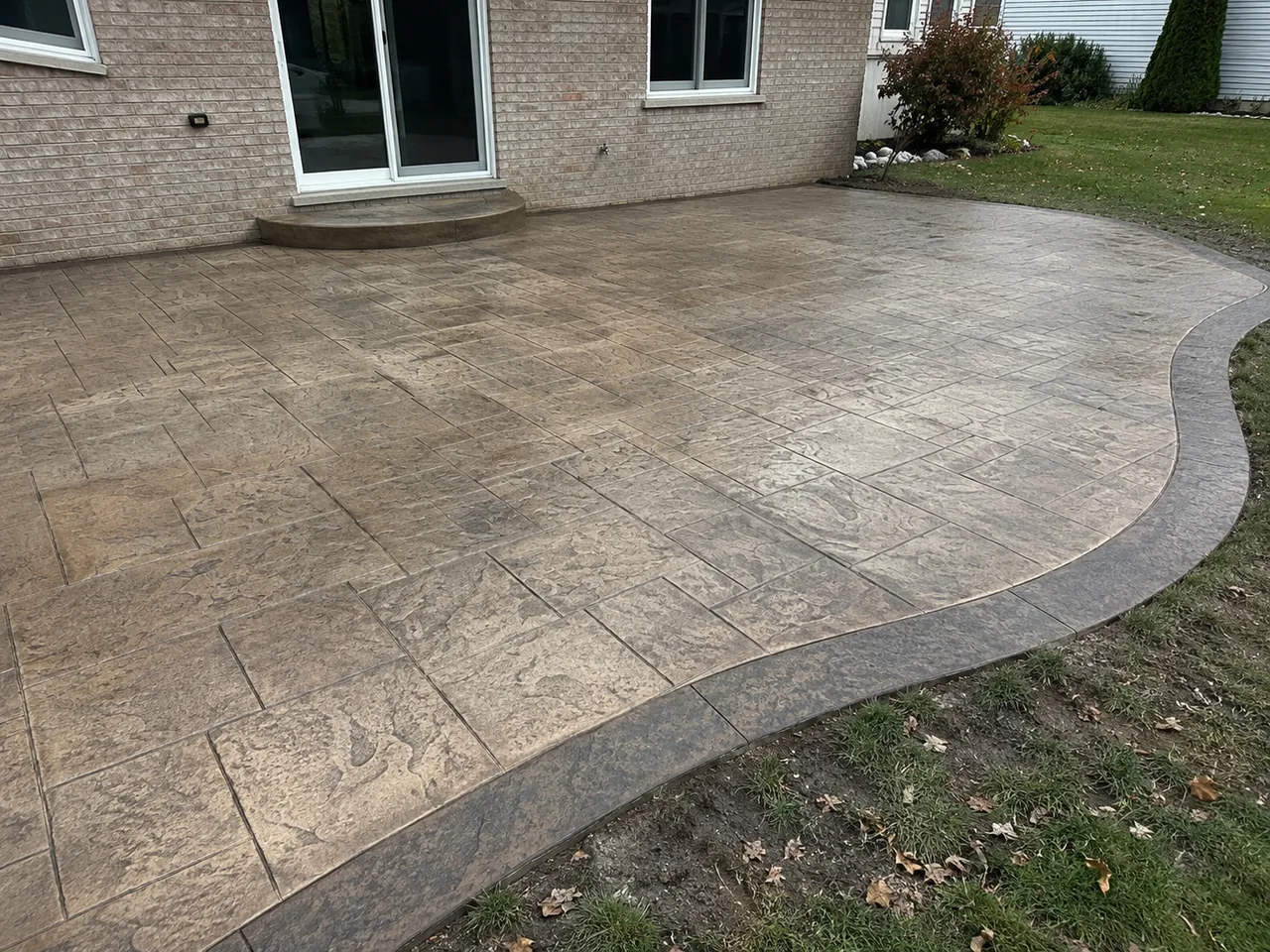
Most people who ask about pavers are really asking for the look — the pattern, the color, the cut-stone character. That's exactly what stamped concrete was invented for: running brick, ashlar slate and stone patterns pressed into a continuous slab with color integral to the concrete. You get the pattern without the joints, which in Michigan means without the weeds, the ants, the sand renewal and the re-leveling. It's the option paver brochures don't mention.
The honest bottom line
If you want a patio you can build yourself in stages, repair block by block, or take apart someday — pavers, genuinely. For everything else in a Michigan backyard — staying flat through winters, less maintenance, lower installed cost, and the decorative looks covered by stamping and exposed aggregate — the math lands on concrete, which is part of why we've spent 37 years pouring it. Run your own numbers: our instant estimator gives you the concrete side of the comparison in a couple of minutes.
Get a Free Estimate
Family-run and serving Metro Detroit since 1989. Get an instant ballpark online, then a free on-site quote.