
A cracked garage floor is not automatically a floor that needs replacing — but the crack itself will tell you which category you are in. The question is not how bad it looks. It is whether the slab is still sitting still.
The short version
Hairline cracks in a floor that is otherwise flat and solid are usually cosmetic, and patching or coating is fine. Cracks with vertical displacement — one side sitting higher than the other — mean the base underneath has moved, and no coating or overlay will hold over ground that is still settling. That floor needs to come out.
What the crack is actually telling you
Concrete cracks. All of it, eventually. What matters is why, because that decides whether you are looking at a surface problem or a foundation problem.
Shrinkage cracks happen as fresh concrete cures and gives up water. They are typically narrow, often follow no particular line, and they stop moving once the slab has cured. A garage floor with a few tight hairlines and no height difference across them is a sound floor with cosmetic cracks.
Settlement cracks are a different animal. These form when the ground under the slab moves — poorly compacted backfill, a plumbing trench that was never properly filled, or a slab poured on loose fill instead of a compacted base. They tend to run long and continuous, they open wider over time, and critically, the two sides often end up at different heights.
Here is the test you can do yourself in about ten seconds. Run your fingertips across the crack. If both sides are level and it is just a line, that is a surface issue. If you can feel a lip — one side higher than the other — the slab has broken and the halves are moving independently. That is structural, and it changes every decision that follows.
When patching is genuinely enough
We will tell you to patch when the floor deserves it. That means:
- Cracks are tight, with no height difference across them
- The floor is still flat — no dips, no rocking when you walk it
- The concrete rings solid rather than sounding hollow when tapped
- The surface is intact, not flaking or crumbling underfoot
A sound slab with a few cracks can be cleaned out, filled with a proper semi-rigid or epoxy crack filler, and left alone for years. Spending five figures to replace a floor like that is money you should keep.
The resurfacing and epoxy question
This is where most money gets wasted, so it is worth being blunt about it.
An overlay, a microtopping, or an epoxy coating is a finish. It is not a structural repair. It has no capacity to bridge a slab that is still moving, and it never will, no matter what the product literature suggests. Put a beautiful epoxy floor over a slab with active settlement and the crack reappears through your new finish — sometimes within a single winter. You have then paid for the coating twice: once to install it, once to grind it off.
Coatings are an excellent choice on a sound floor. They are the wrong choice as a way to avoid dealing with a bad one. If someone quotes you an epoxy job over a displaced crack without mentioning the slab underneath, that tells you something about the quote.
Why Michigan garage floors fail at the door first
Look at where your floor is worst. On most garages around here it is the first few feet inside the door, and there is a straightforward reason.
All winter you drive in carrying road salt in the slush packed around your tires and wheel wells. That salt brine drips onto the floor and sits there. Meanwhile the slab at the door opening is the one part of the floor genuinely exposed to freezing, because the door is not an insulated wall. So you get the same freeze-thaw and chloride attack that eats driveways — concentrated in a strip a few feet deep.
The result is surface scaling and spalling near the opening while the back of the floor still looks fine. It is also why a garage floor should be pitched toward the door: meltwater needs somewhere to go. A dead-flat or backward-pitched floor holds salt water against the concrete every time you park a wet vehicle, and it will show.
What a replacement actually involves
When a floor does have to come out, the tear-out is the easy part. What determines whether the new floor lasts is everything that happens before any concrete arrives.
- The old slab comes out completely — broken up and hauled away, not covered over.
- The base gets rebuilt. This is the step that failed on the floor being replaced, and it is the step that gets skipped on cheap bids. Compacted aggregate, properly graded.
- Reinforcement. A garage floor carries concentrated wheel loads and sometimes a jack or a lift, which is different from foot traffic.
- Pitch to the door, planned before the pour rather than chased afterward.
- Control joints cut in so the slab cracks where you decided it should, not where it chooses.
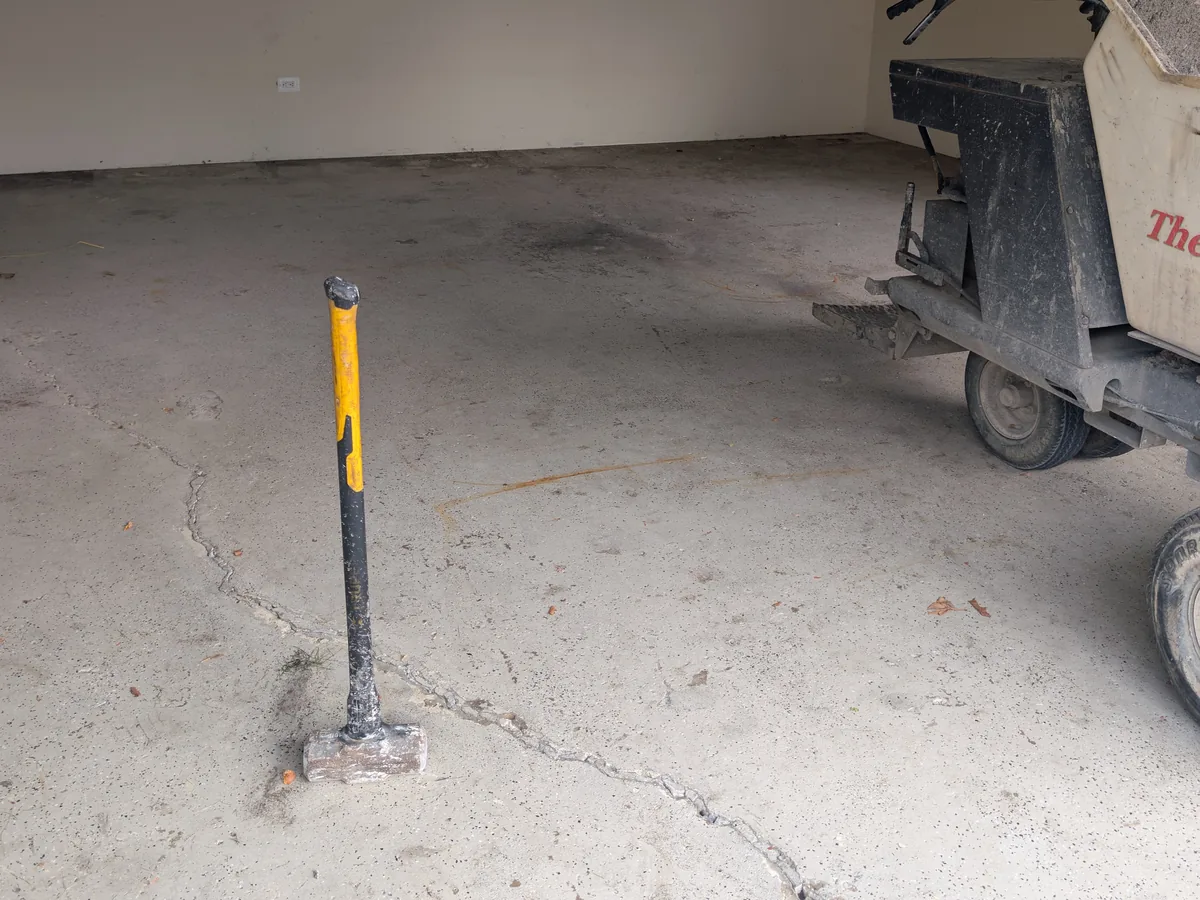
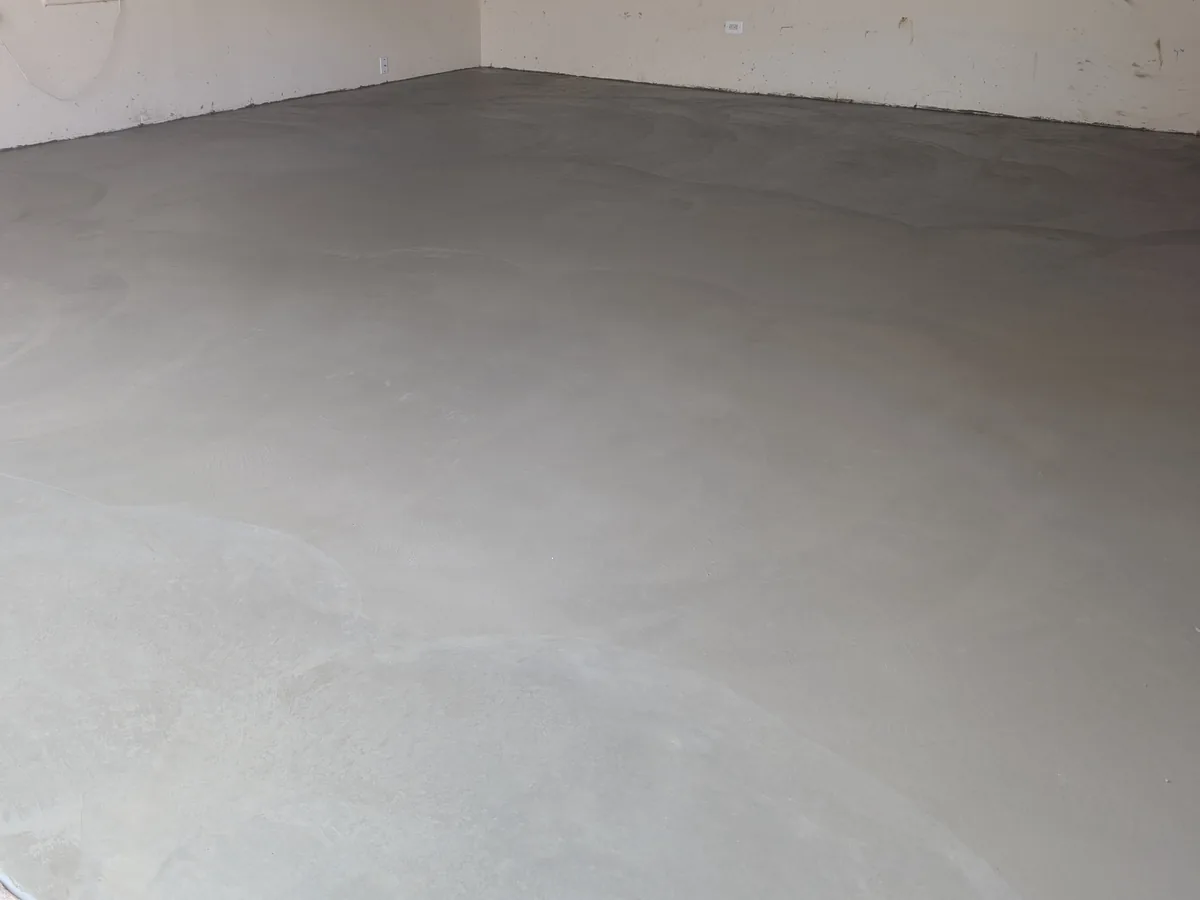
The photographs above are a Dearborn Heights garage we replaced. The first shows the failure: a crack running clear across the slab, wide and continuous. The second is the finished floor — flat, steel-troweled, and ready for a coating if the homeowner wants one later. The difference is not the finish. It is what went underneath.
What it costs, honestly
Garage floors price by square footage like any other flatwork, and a single-bay or two-bay garage is a small pour — which means the per-foot rate lands at the higher end of our tiers, because mobilizing a crew, equipment and a concrete truck costs roughly the same whether we are pouring 400 square feet or 1,200. There is also a project minimum that covers a one-day job.
What moves the number on a garage specifically: how much has to come out, whether the base needs rebuilding or just regrading, access for getting material in and debris out, and whether the apron where the floor meets the driveway is being tied in at the same time. Run your dimensions through the instant estimator for a ballpark, then we measure on site for a firm figure.
One thing worth doing at the same time if you are already tearing out: if the apron or the driveway approach is also failing, doing both in one mobilization is meaningfully cheaper than two separate visits.
Not sure which one you are looking at?
Send us a photo of the crack, or we will come look. If your floor can be patched we will say so — there is no version of this where we make money talking someone into replacing a floor that did not need it, and a homeowner who trusts us is worth more than one job. Read how to choose a concrete contractor if you want to know what else to ask before you hire anybody.